
It’s...in between times
the site of production is no longer the site of power

You might know the meme about the awkward time between Christmas and the new year. It corresponds to an eerie feeling: being in between. The week is a non-place, the annual equivalent to getting drunk at an airport bar, or maybe a non-time, the loosening of the work calendar’s grip over white collar schedules. Blog theorist Mark Fisher has a name for this sort of thing. He calls it a “time out of joint.” 1

The inverse of “an idea whose time has come,” time out of joint belongs to the moments that don’t fit sweeping narratives. I was thinking about Fisher’s lost futures — refuge to thoughts out of season — while I decluttered my life this week. I have an upsetting number of tabs open on Chrome. Each one haunts me like an idea whose time never came.

Reading the same article about Why Trump Won Again written five different ways some fourteen months after the fact evokes that feeling of interregnum. One of the juicier finds in my mess, however, is worth a blog post: an old British documentary called — what else — “Between Times.”
I have no idea how I stumbled upon this treasure. Clicking the back button leads me nowhere, which suggests I right-clicked a hyperlink somewhere that sent me careening through cyberspace. Well, how did I get here? The feeling of discovery and disorientation that comes with the caesura of New Year’s is apt. [Yes, Goodrich blew past his deadline—Eds.]
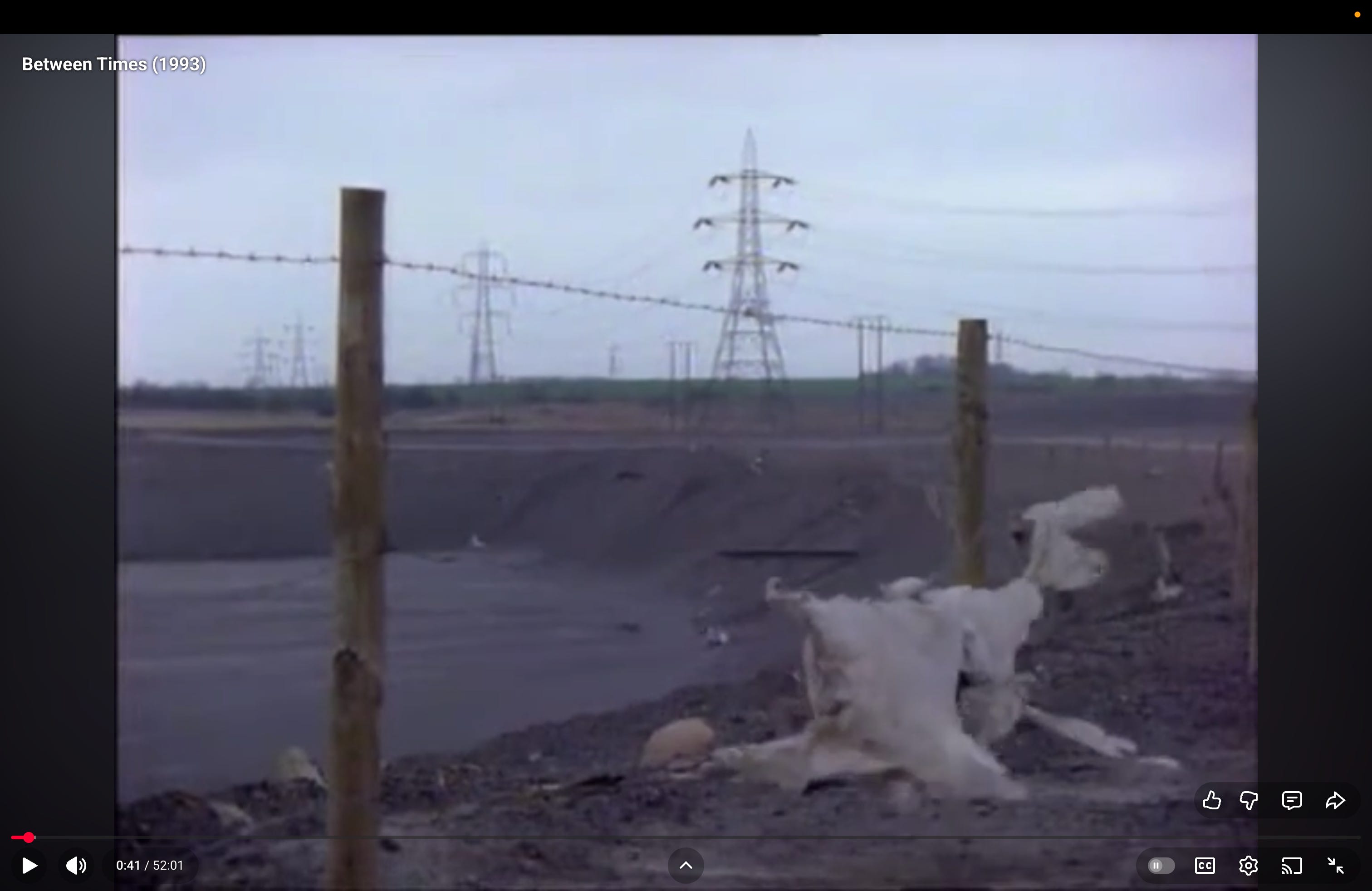
The video opens to a grainy wasteland, all pit and wire and power lines.
“Just because we’ve lost our bearings,” a voice intones in some regional British variant, “what gives you the right to say that we’ve run out of alternatives?”
Then a harsher accent cuts in with the authority of a narrator — “he demanded of his opponent.”2
A third voice: “First of all, who says we’re lost? Quite the opposite. We could at long last be arriving. What I am saying is that all you can offer is just one more fiction.”
Again our narrator: “That sense of things, now so freely spoken of, of being deceived, disorientated, adrift, plagued by too many unfinished stories. Once there was rhyme and there was reason, they said, you were home and there was away. But for some, when a system of beliefs breaks down, it’s as if words in a dictionary are slipping around, unable to get a grip.”
The image of the wasteland fades, replaced by a montage full of characters I don’t recognize: competitors in a track race, a vaguely propagandistic visage with bushy eyebrows (Leonid Brezhnev?), a stately man who is possibly Prince Charles whispering into the ear of a woman who might be Princess Di.
The narrator: “well, that’s the new freedom, others say. So what if meanings just evaporate and reality is, at best, only virtual? Who cares for all those old questions? It’s not the first time nor the last the world feels as though it’s been turned upside down. We’re in between times, that’s all.”
The Pooh-like matter-of-factness of the dialogue belies the tragedy the characters face. The apocalyptic scene at the film’s start doesn’t depict some nuclear winter but the end of history, the shunting of the world off the timeline of progress. The pit isn’t the gateway to hell, but a shuttered coal mine, which may amount to the same thing.
“Between Times” is a story about the obsolescence of the working class, both as the protagonist of world history and as the engine of economic development in modern Britain. All that is solid melts into air, the vital organ of industrial labor turns vestigial. Coal miners in northern England come to know themselves as living anachronisms, caught between ages.
While deindustrialization is the backdrop to “Between Times,” the film’s genius lies in instantiating a sense of dislocation in the viewer through its central conceit: a Socratic dialogue between A, a traditional labor socialist, and Z (pronounced Zed), a leftist impatient with old Marxist pieties. Tossed from one speaker’s argument to the next — interspersed with scenes from The Third Man (1949), a fable portraying Margaret Thatcher as a lullaby witch, and interviews with working-class Brits adjusting to post-industrial society— we never do quite find our bearings.
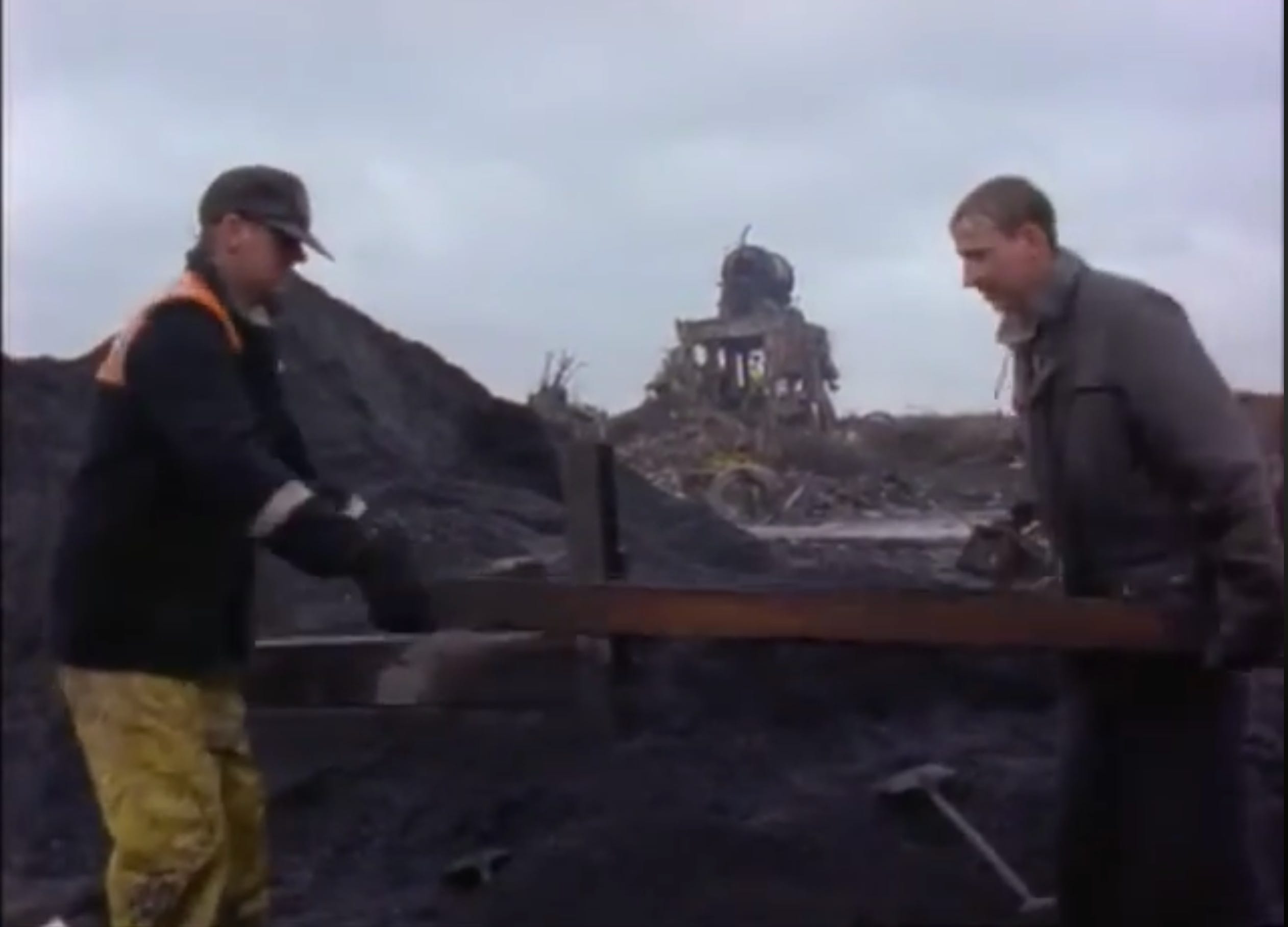
The film was released in 1993, the year I was born. A bit of googling reveals some historical context that fills in the story: in 1991, the Thurcroft Colliery, a coal mine in South Yorkshire, was shut down, leading the town’s workers to organize a campaign to buy out the company from British Coal. The recession buffeting Great Britain in those years gave the Labour Party hope of a hung Parliament in 1992, but instead the election yields a fourth consecutive victory for the Tories. The workers’ campaign fails. (A letter from the coal minister: “I am afraid I have to re-emphasize the point that decisions about Thurcroft are matters for British Coal and not the government.” Never mind that British Coal was run by the government!) As one of the workers puts it, “the site of production is no longer the site of power.” Without the leverage of a shop floor to contest, the left is dead and history has ended. Time is out of joint.
That, at least, is what A may argue, even as he struggles to find some cause for optimism in the workers’ cooperative efforts. Z responds: “you may need to interpret this story in terms of socialism and redemption, but for me that’s the curse of the political dreamer. That is, you take a small local story, you try and conjure something hopeful out of it, then you elevate it to the status of a myth.” As for the workers? “They’re after their jobs, not redemption or socialism whether you like it or not.”
Maybe I take to this narrative device because it mirrors the dialogue between the angel and the devil on my own shoulders. In the universe of “Between Times,” the “row” between A and Z dates to 1968, when the French working class stood with bourgeois student protestors to turn the country upside down. But I like to think that both tendencies, the socialist utopian and the pomo cynic, also lived within the filmmaker.
Marc Karlin doesn’t have a wikipedia page so I can’t read a quick bio of him. But if the NYU cinema studies department is to be believed, Karlin is “Britain’s most important but least known director of the last half century.” According to an obituary, he helped shape the programming for Channel 4, the publicly owned, privately funded television station that now airs The Great British Bakeoff. (If PBS ever ran an experimental film essay about disillusioned lefties in America squabbling over what is to be done, I would love to see it.)
Karlin lived in Paris during May 68 and, per The Independent, expected to make “newsreels for the revolution.” Some of his footage, apparently, made it into Chris Marker’s Le fond de l’air est rouge in 1977, which Karlin then produced for English-speaking audiences for Channel 4 under the title A Grin Without a Cat.
To borrow a bastardization of Gramsci you see a lot these days: “the old world is dying and the new world struggles to be born.” A grin without a cat, a mine without its workers, signs without the signified: now is the time of monsters.3
The deposed leader of Venezuela is now sitting in detention a few miles from me in Brooklyn. Time is out of joint: 2026 is starting out just like 2003.
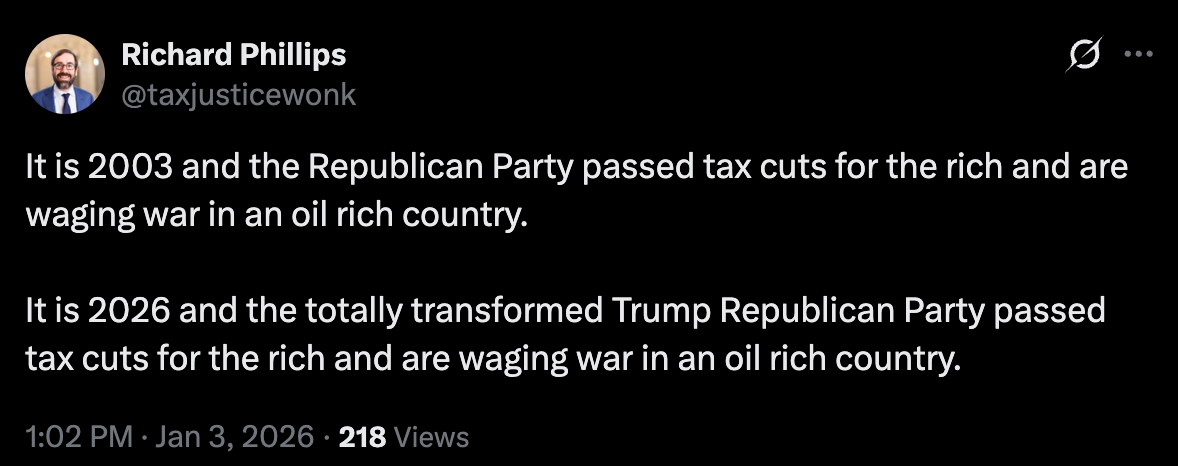
Now is the time of monsters, but then, so is every age. Maybe time is never in joint, every decade a duel whose victors are haunted by the vanquished. We can’t always see or sense or remember the forces that we react against, but they nevertheless remain as ghostly appendages to our actions.
Thanks to a blog dedicated to Karlin’s legacy, I found a snippet of a letter about “Between Times” that the director wrote to his cinematographer: “this film will be as much about the political unconscious as it will be about politics….the film will examine how we represent politics to ourselves, how we live with these representations and our need for them.”
The film is a snapshot of a moment in flux. Sometimes, so too are tabs.
Burn After Reading
Another piece I encountered this break probably had direct influence on “Between Times.” Cultural theorist Stuart Hall’s essay “Gramsci and Us,” published in the collection The Hard Road to Renewal in 1988, treads much the same terrain as the film. You can almost hear Z taking A to task in these lines:
The Left often waited patiently for the old rhythms of the class struggle to be resumed, when in fact it was the forms of ‘the class struggle’ itself which were being transformed. We can only understand this diversification of social struggles in the light of Gramsci’s insistence that, in modern societies, hegemony must be constructed, contested and won on many different sites, as the structures of the modern state and society complexify and the points of social antagonism proliferate.
and
I’ve been talking about Gramsci in the light of, in the aftermath of, Thatcherism: using Gramsci to comprehend the nature and depth of the challenge to the Left which Thatcherism and the new Right represent in English life and politics. But I have, at the same moment, inevitably also been talking about the Left. Or rather, I’ve not been talking about the Left, because the Left, in its organised, labourist form, does not seem to have the slightest conception of what putting together a new historical project entails. It does not understand the necessarily contradictory nature of human subjects, of social identities. It does not understand politics as a production.
The point is that the Thatcherite program of “regressive modernisation” understood the historical moment (the “conjuncture,” in Gramscian terms) better than the left. Socialists become retrograde when they cling to easy answers provided by Marx without reckoning with the new formations/identities/constructions that appear in history. Concretely, I think the most durable construction is that hybrid monster known as the professional-managerial class. I don’t know if Hall would agree, but his injunction is the same: the work of politics is the transformation of what it means to belong to a particular identity.
If the site of industrial production is no longer the site of power for the working class, then the site of cultural production just might be.
The line comes from Hamlet, which is news to me. It’s a major theme of Derrida’s Specters of Marx (1993) and an organizing principle to Fisher’s “puncept” of hauntology. In Ghosts of My Life, Fisher describes cassette hisses and vinyl snaps that make their way onto .mp3s: “Crackle makes us aware that we are listening to a time that is out of joint; it won’t allow us to fall into the illusion of presence.”
I couldn’t for the life of me understand those final three words through the thicket of the dialect. But toggling on YouTube’s closed captioning solved it for me. I wondered if the subtitles were the work of a dedicated archivist, but given other errors in deciphering the accent — transcribing “now” as “know,” for example, and “some” as “song” — the captions must be auto-generated.
The dramatic formulation is actually Zizek. A more literal translation of Gramsci yields “morbid symptoms” instead of monsters: La crisi consiste appunto nel fatto che il vecchio muore e il nuovo non può nascere: in questo interregno si verificano i fenomeni morbosi piú svariati.