
It’s…industrialized thinking
The mass production of thoughts leads us to falling into manholes

On Monday, a few blocks from Rockefeller Center, Donike Gocaj parked her Mercedes on East 52nd Street, opened the car door, and plunged to her death. She had fallen down a utility hole.
Hell Gate described the news as “every New Yorker’s worst nightmare.” Online rubberneckers speculated that Gocaj was distracted by her phone, but an IRL witness took pains to emphasize that she wasn’t at fault, telling the New York Times it was just a “freak accident.” The hole’s access cover had been dislodged by a truck barely ten minutes before.
For weeks I’ve been chewing on a conversation I had at the end of March, at an organizing conference for white guys. I was talking to another dude about my decade-plus in therapy, and he recited a parable for me. This was the gist:
A man walks down the street. Every day, without fail, he trips in the same spot and falls down a manhole. One day, he decides that he has had enough. “I’m not going to fall down the manhole today,” he says to himself. Treading very carefully, he sets off down the street, steels himself to step around the manhole, and immediately trips and falls in.
Like a lot of folk wisdom and the evolutionary origins of trees, the parable is polyphyletic — consisting of disparate starting points that converge on the same destination. Falling into deep holes is a popular metaphor for depression and addiction, which is maybe why support groups and 12-step programs are fond of the imagery.1
There’s a name for tripping Looney Tunes-style into a utility hole again and again and again: repetition compulsion. It was the subject of this blog’s very first entry, on the relationship between AI and the subterranean intelligence that is our own unconscious.

My argument in the halcyon days of 2023 was that, far from liberating humanity from the bondage of labor, artificial intelligence would shackle us to our own psyches. Rather than endowing us with superhuman abilities, my hunch was that, by eroding our capacity for judgment, the prevalence of AI will eventually make us all more machine-like. I’m picturing the Roomba knockoff I once had that just bonked into a chair like that was its job.
Or a man who can’t help himself from falling into the sewer.
The age of artificial intelligence is often billed as the second coming of the Industrial Revolution, the comparison evoking a spike in economic productivity associated with the combustion engine. The Industrial Revolution, of course, involved unleashing energy stored in ancient dinosaur guts to produce massive amounts of goods. So far, the race to develop artificial intelligence has involved consuming massive amounts of energy to produce not goods, but data.
If AI proves similarly epochal to the steam engine, it will be because changes in scale of data production lead to changes in kind to intelligence itself.
But I don’t mean AGI. I mean a diminishment of intelligence, something more akin to the mass produced thought. It’s…industrialized thinking.
In pursuing AGI or superintelligence or some other rebranded singularity, AI companies have converged on the same strategy: the brute force of data processing through large language models. Insiders know it as the “pure language” hypothesis.
Karen Hao, a journalist who has covered OpenAI since the company’s early days, explains the hypothesis in her book Empire of AI:
Language, the theory goes, is the primary medium through which humans communicate, meaning all of the world’s knowledge must at some point be documented in text. It follows that AGI should be able to emerge from training an algorithm on massive amounts of language and nothing else.2
Hao goes on to detail how the initial success of ChatGPT inspired an arms race within the industry to win the “pure language” sprint to superintelligence. OpenAI, then Google, then Anthropic needed bigger and bigger datasets to train their models. Safeguards against surveillance quickly fell to the logic of scale. When Reddit posts and Wikipedia pages (containing such marvels as the benefits of vacuuming out your ear canal and the history of execution by elephant) weren’t sufficient, in went “Books2,” a compilation of torrented novels and journal articles. Quality standards for the datasets also disappeared, as OpenAI removed filters meant to prevent its chatbot from learning from teenage boys on 4chan or the most perverted parts of the Dark Web.
In some ways, Hao’s account reads like an addiction memoir. Just one more dataset. I’m not going to fall down the hole today. Just one more dataset.
Are large language models finally the machine capable of thinking, or are they no more than glorified autocorrect? Can the simulation of intelligence eventually emulate actual intelligence?
This is the “stochastic parrot” question and I want to step around it. Because if we look to how proponents actually use AI right now, it doesn’t matter which side of the debate you fall on. It’s clear enough that AI is used to simulate the effort that goes into the craft of thinking.
The result is shoddy manufacturing of ideas at scale — in a word, content.
This extends beyond Stanford undergrads Chat-ing their way through college and those LinkedIn posts riddled with Claude’s telltale tics. AI boosters conceive of thought itself in a way that degrades thinking in order to enable it to scale. Take Azeem Azhar.
Azhar is a technology writer who admits to “outsourcing” the mundane parts of thinking to artificial intelligence. Drawing on neural system research, he makes a distinction between “cognitive offloading” and “cognitive surrender.” To protect himself from the latter, in which the human is subordinate to the machine, Azhar comes up with ideas in mercifully analog states — while enjoying a hot shower or doodling on scrap paper. After all, “thinking is my livelihood,” he writes, “if I stop thinking new things, I’m not doing my job.”
Azhar’s language betrays him. He equates “thinking” with “thinking new things,” always giving thinking an object. In Azhar’s formulation, a thought is a thing that can “arrive” or “appear,” at least in primitive form, to the thinker. Picture the apple that bounces next to a drowsy Newton, the thought occurring to him that matter attracts matter.3
But if a thought is a thing, it is only a beginning of something else. Thinking is a process. Famously: the thought process.
Newton had prisms and needles and rulers to facilitate his thinking. Azhar has artificial intelligence, which, as he tells us, has “become completely ambient, embedded in every process I run at work.”
But in the thought process — the very thing where Azhar has now embedded AI at every level — the thought changes. It develops, takes new forms, gets sharper, becomes inverted, leads to dead ends and higher orders. Thinking is a thinking through. To Azhar, it’s just a thinking of. All you need is a good prompt and voilà: the apple becomes a theory of gravity.
This is a conception of intelligence that allows it to be industrialized: thought as raw material. By framing an idea solely as an object, a germ whose care and cultivation we can outsource to Nvidia chips, we lose a conception of thinking as process. The skills needed to service a machine are very different from the skills needed to hone a craft.
The promise of LLMs is that, with enough bips and boops, we can skip the craft of thinking to arrive at fully-packaged thoughts at an industrial scale.4
The claim of industrial thinking, then, is that we can sunder an idea from its realization, a thought from its expression, a brain from its body. I am not so sure. Ideas matter insofar as they are expressed in the world, which means that you cannot cleanly sever style from substance. How we arrive somewhere surely matters as much as the destination, which is why hiking up Mount Washington reveals sweeter views than driving up it.

Using AI, Azhar built an agent he calls The Stylometer, trained on 60,000 words of his own writing. He calls it a “synthetic editor” that keeps his voice and rhythm on track.
Azhar leaves the question of whether it remains his voice and rhythm unasked. He still recognizes himself in the prose.
Another convergence: a trio of New York Times opinion essays from the week of my men’s conference suggesting the beginnings of a humanistic backlash to industrialized thinking.
First, Ezra Klein. The ur-blogger levels a similar critique against Azhar: “the arrival of an idea is less generative than the work that goes into chiseling that idea into something publishable.” The process of thinking changes the content of the thought, which is why craft matters so much. “If I have gained anything in this process,” Klein reports of writing the essay, “it has been in the toil that followed inspiration.”
The toil is the point. By relieving us of this craft, industrialized thinking sands off the rough edges of thought to better manufacture content at scale.
Part of that sanding happens before the data gets stuffed into the maw of the LLM in the first place. Klein writes of companies asking their employees to act in ways that make themselves more “legible” to AI. Instead of the water cooler conversation, try the Slack message. Don’t call your colleagues over the phone, record voice notes so that a disembodied intelligence can listen in. The LLM hungers for 0s and 1s; anything that cannot be reduced to an input is factory scrap.
This is why Klein cites an aphorism that was itself digested from Marshall McLuhan by John Culkin: “We shape our tools and thereafter they shape us.” For the Marxists, the relationship between us and the world is dialectical. For the Freudians it is dynamic. AI acts on us whether our bosses ask us to become legible to it or not.
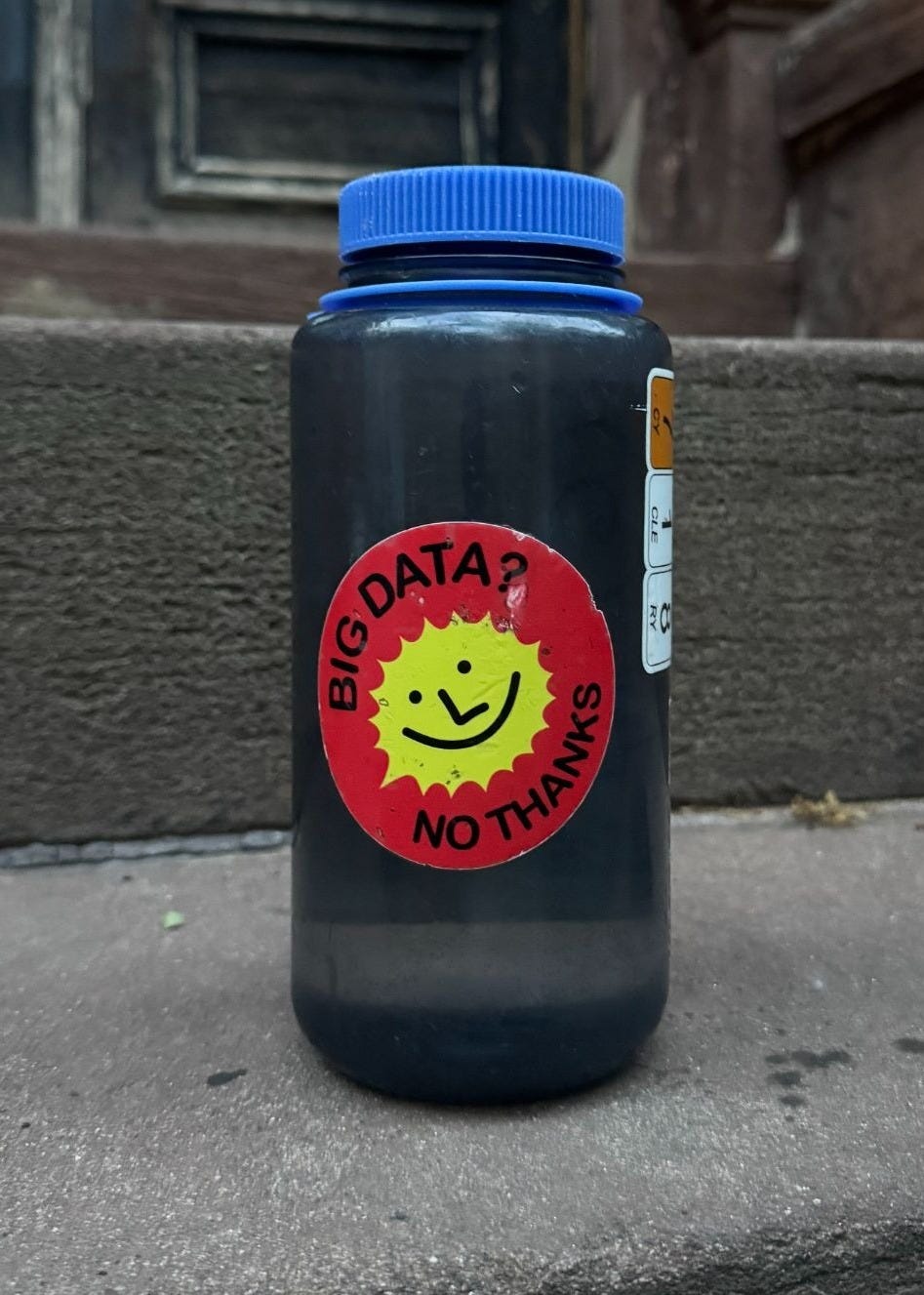
The problem with Big Data is not that it is too big (though surely also this) but that it is too small. It cannot integrate illegibility — the strange, the unquantifiable, the unrecognizable.5
And yet what is regurgitated is nevertheless uncanny, identifiable but off.
Klein opens his essay with the myth of Narcissus because this uncanniness is becoming enamoring rather than repulsive. The more you use it, the more Claude reflects you back through the other of computer code, processed in a personalized factory. The unintelligible bits — the parts one might trip into a manhole over — have been discarded.
The use of AI, I suspect, will begin to resemble repetition compulsion as users turn to it to affirm themselves against a world they cease to recognize. But it is only through the other that we can learn of ourselves.6 What AI gives us is not the radical otherness of a dreamworld — that would, ironically, require an openness to the utter strangeness of our own — but a fantasy of familiarity.
I can’t help but stare at the vision the machine offers. Show me again, mirror, that image of myself where I am known in my fullness, where I am loved without toil.
It is little wonder why online commenters thought that Gocaj might have been distracted when she stepped out of her vehicle and to her doom. The technology we use increasingly absorbs us into it. It is meant to be narcotizing.
But as the parable implies, there is no escape from ourselves. Our minds, too, have manholes.
Narcissism, or Narzißmus, was coined by Freud after the mythological youth who wasted away in front of his own image. The word shares a history with “narcotic.” Both are related to the Greek νάρκη, meaning “numbness,” “torpor,” or “inactivity.”7
If industrial thinking outsources thought to the machines, then it leaves us with action. In many ways, that’s the whole pitch: let AI do your thinking so that you are free to act the way you would in absence of the necessity of toil. Instead of making us all more productive, though, it seems to be making us all more consumptive.
Agency is the subject of a second Times essay, by Sophie Haigney, from that week. In another era, we might have called agency “freedom” — the freedom to do what we will, unencumbered by the state or tradition or superstition. But Haigney juxtaposes it against another word — “courage” — pointing out that agency is comparatively bloodless. “Agency is about action,” she writes, “but it tells us nothing of direction.”
Silicon Valley’s obsession with agency derives from the billions that a few men have made in disrupting the status quo. No one gave Mark Zuckerberg permission to rate his Harvard classmate’s looks and spin it into a global surveillance empire — he just did it. Artificial intelligence companies work in much the same way. Steal the labor of journalists, feed it into your souped-up search engine / doomsday machine, and settle the lawsuits once you’re too big to fail. (That this is profoundly anti-social behavior makes their profoundly anti-social products more legible to me.)
Haigney also compares “agency” to the buzzword of our college education, “structural.” In my undergraduate days, it felt to me that I was suffering from a surfeit of thinking and a dearth of action. What was the point of taking action if I ascribed to Marx’s theory of historical determinism, or the all-imposing, almost ontological structures of white supremacy and patriarchy? These ideas left me feeling small and powerless — non-agentic, I guess — in a way that made it easy to elevate critique over change, thought over action.
But agency elevates action over thought. Haigney paints a picture of the endpoint of Silicon Valley agency culture after industrialized thinking: “constant hamster wheels of action, unmoored from any values, no compass to be found.”
Or — tripping head over heels into a manhole.
Does smoothing out the pavement mean that we won’t trip on the chink in the sidewalk? Or does it mean that we’ll just slide even faster into the sewer?
Suppose the United States invaded a foreign country promising to liberate its people. Is this 1965, or 2004, or 2026?
The technological prowess of the US military has advanced to a horrifying degree since Vietnam. And yet. As Yonatan Touval pointed out in the third Times op-ed from that week, technical mastery of war has proven shockingly inadequate to the job of winning one.
The vast intelligence apparatus that allowed the US and Israeli military to infiltrate Iran’s surveillance infrastructure and the inner sanctum of its leadership has resulted in the humiliation of the superpowers. Touval puts it well: “A system can tell you where a man is. It cannot tell you what his death will mean for a nation. Such systems are trained on behavior, not on meaning — they can track what an adversary does but not what he fears, honors, remembers or would die for.”8
When the capacity to do something overwhelms the judgment of whether or not to do it, we call it immature, maybe even unthinking, perhaps an example of repetition compulsion. The push for comparative advantage by sifting through massive amounts of datasets can quickly amount to mistaking brilliant tactics for a winning strategy.
The recourse Touval turns to is, basically, a freshman seminar on the Greats: Shakespeare, Thucydides, Tolstoy. Not because they make generals wage war better, but because the canon is littered with examples of hubristic leaders setting off chains of events that lead to their downfall.
You might even call it tripping into manholes.
Burn After Reading
I just finished Liz Pelly’s Mood Machine, on the “rise of Spotify and the costs of the perfect playlist.” The book narrates how the streaming giant’s data strategy cornered the market of passive listeners, pushing out the concrete sounds of working musicians for an industrialized ambience.
Listening to music in a way that’s “legible” data optimization, Pelly writes, leads to a “bizarre parallel music world” of knock-off Muzak (yes, knock-off Muzak, a copy of a copy. My favorite part of the book was the history of Muzak, the original music subscription service):
When the recommendation systems are optimizing for extended listening sessions, when they are filled with made-up genres, when music that sounds like other music is what’s most data-blessed, the reality of what we’re hearing on the playlists and AI DJ streams isn’t music culture, it’s Spotify culture. It’s a weird data-refracted version of music culture.9
Vibes, moods, and aesthetics have become memes because their lack of specificity makes them so easily marketable by corporations. You chase your dream of being the type of person who partied in Williamsburg lofts in 2002 by listening to a “This Is…Indie Sleaze” playlist at Blank Street Coffee in 2026.
The pop music philosopher and scholar Robin James, in theorizing why music culture has become entwined with the language of ‘vibes,’ has argued that in embracing vibes, we’ve adopted the language that algorithms use to perceive and to organize us. She has explained vibes as a way to typecast users not based on identity but on their actions and data breadcrumbs, in terms of the ‘trajectory’ that someone might be on as a user. ‘We’ve learned how to interact with algorithms so that they perceive us in ways that we want to be perceived,’ she said in a 2023 podcast interview. ‘You’re pre-packaging yourself as a data-subject.’10
There is a great irony that a streaming library that gives us the great diversity of the world’s music at our fingertips – utterly seamlessly – has popularized generic moods as a form of consumption. An eerie noiselessness has filled the vacuum left by no longer having to choose a favorite band. The almost-specific ambience leaves impressions of something else, a ghostly reminder of what we’ve lost.
Anyway, see you at Belle and Sebastian tonight.
The myth of Sisyphus is one obvious origin point for the parable. Maybe the phrase “if you find yourself in a hole, stop digging” is too. Another variant might be found in The West Wing: “I’ve been here before and I know the way out,” says Leo McGarry, an avuncular alcoholic, to the hot-headed Josh Lyman struggling with PTSD. But the best candidate for the parable’s origins is “Autobiography in Five Short Chapters,” a poem by the Mormon cabaret singer Portia Nelson, “one of the most beloved nightclub performers of the 1950s.”
This is on page 129
There’s an etymological case for the thought as a thing. The quaint English word “begrip,” as in “the knight begripped his sword,” shares a root with the German begreifen, meaning “to comprehend.” Our word “grasp” carries both connotations — you can grasp a handle as well as an idea. The word for “concept” in German is Begriff, which plays an all important role in Hegel’s Phenomenology on the development of reason through abstraction to expression.

Sometimes this is literal, with AI systematically incapable of telling different Black people apart.
This was a theme of a blog from February, on the social view of power: my self-definition depends on what I am not, which is why I need you to figure out who I am. A core insight from Hegel.

As well as, according to Wiktionary, “stingray.”
“What would you die for” strikes me as a good prompt for thinking, deeply human as well as deeply personal. To die is to not be a machine. If I’m coming out of this blog post with two unresolved questions, it’s these: what is my manhole and what would I die for?
This is page 116
See pages 122-123
“Agency is about action,” she writes, “but it tells us nothing of direction.” That quote, and the following, related riff on Muzak. reminded me of a movie scene...which Google's Gemini 3 immediately pinned down! "The Blues Brothers (1980): During the chaotic final climax, Jake and Elwood are being chased by hundreds of police officers and military personnel through the Cook County Building. They sprint into an elevator, the heavy metal doors slam shut to block out the shouting, and they stand in dead silence as a cheerful, tinny Muzak version of "The Girl from Ipanema" plays. When they reach their floor, the doors open right back into absolute chaos."
"The claim of industrial thinking, then, is that we can sunder an idea from its realization, a thought from its expression, a brain from its body. I am not so sure." Well, Scientific American tells us some creatures can do just that! "This Sea Slug Can Chop Off Its Head and Grow an Entire New Body—Twice" https://www.scientificamerican.com/article/this-sea-slug-can-chop-off-its-head-and-grow-an-entire-new-body-twice1/